Mind in transition

This blog is about me, my family, and my social work career.

My Photo
Name:
Location: Canada

I'm confused, but still faithful; opinionated, but still thoughtful; steady, but still growing.

Thursday, April 23, 2009

The power of not giving a rat's bahookie


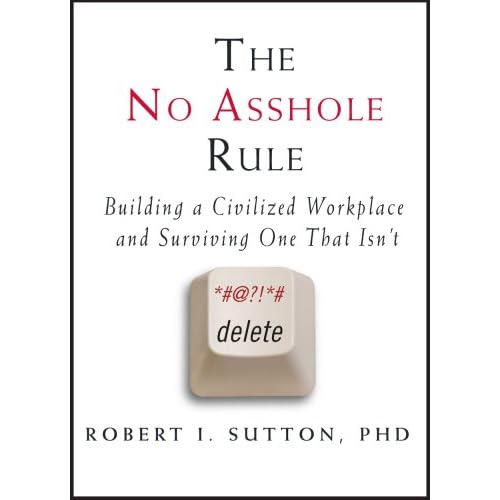
I just finished reading The No Assholes Rule. Author Robert Sutton gives an overview on the concept in this video.


I think my favourite part of the book is when he talks about the importance of indifference. He says that's unusual as most business books talk about passion and excellence (he even includes two favourites of mine: Dennis Bakke who wrote Joy at Work and Jim Collins who wrote Good to Great). But in a situation in which you don't have the power to affect change, becoming indifferent is a key to surviving.


This is my task in the next while: to stop caring so much about the injustice at work and remove myself emotionally form the situation. My natural inclination is to be very passionate about issues of justice. As I have limited power, I need to be careful of my emotional investment.

Tuesday, April 21, 2009

Mediocrity

I've been thinking about mediocrity lately. Specifically, about restaurant food (Don't you think that the vowel sound in the last two paragraphs in "restaurant" seem backwards considering how it's pronounced? Restaraunt would make so much more sense. More mediocrity).

I happen to be married to a man who often likes to cook and is quite good at it. This is wonderful and something I'm thankful for. But experiencing good food on a regular basis has made me aware that the majority of the items in the majority of restaurants either lack any originality, or are of low quality, or both.

Examples:
1. I am disappointed every time I order pancakes. It always tastes like a package mix. I know what pancakes taste like made from scratch (heavenly) and I know what color they are inside (not yellow). The last time I had breakfast, on our trip to Saskatchewan, and we had to eat out for breakfast I specifically asked if they were made from scratch, and was told yes. The sorry, flat, chemical-tasting things that arrived on my plate did not agree with that assessment.

2. What's with the whole whipped topping thing? Whipped cream is natural, it does not contain the type of trans fats that things like Cool Whip does, and it tastes 10x better. It takes no time to whip it up if you have the right equipment. So why do restaurants put edible oil products on when they could be using the real thing?


3. Salad dressings that come out of a bottle. I can buy a bottle. I go to a restaurant to have something extra.


4. Soups served out of a can, or worse, out of an envelope. That was the case when I had the minestrone at the restaurant here in Winnipeg in which my server was actually Nia Vardalos's sister. Wouldn't you think that after Vardalos wrote and starred in a screenplay, based on her own family, in which the whole of the extended family were fantastic cooks, that it would be a reasonable assumption that the Vardalos family would actually make the soup by doing things like, say, chopping up vegetables, rather than ripping open a packet of Knox?

But nothing is about quality anymore, it's all about marketing.

Now 'scuse me while I go yell at some kids on my lawn.

Monday, April 13, 2009

The Year of Living Biblically

I have been reading The Year of Living Biblically by A.J. Jacobs. Jacobs is a secular Jew who tackles his lack of knowledge and experience of spiritual things, as well as his desire to find out if he's missing something, by devoting himself to living the bible literally for a year. Included in this memoir is:
  • avoiding sitting anywhere that a menstruating women has sat
  • wearing white all the time
  • observing the Sabbath
  • getting a slave
  • stoning an adulterer

He devotes 2/3 of the year to focus mainly on the OT and 1/3 mainly on the NT.

I was fascinated. I am totally different than Jacobs. He's a Jew, I'm a Mennonite. He lives in New York City. I am a rural girl at heart. He grew up without any religion, I was steeped in evangelicalism from day one. Yet I find myself in complete sync with so many of his observations, like we started out in different parts of a city, started walking and met up downtown.

I always wanted to follow the Bible the right way. I was once convinced there was a right way, and became more worried and confused as I realized that there was no easy answer for what that right way is. Then I put the thoughts out of my mind for a long time. Jacob's book forced them out again.

Jacobs makes it obvious, in trying to follow the Bible literally, that even people who say they follow it literally, don't. Everybody takes an interpretation to it. Everyone picks things to follow and things to ignore as "cultural" or "for that time". I find that freeing, because if there is a right way, even amongst those who take the title Christian there are so many differences that it is almost a sure thing that we are all getting some things wrong on a regular basis. Thus the need for, and the supply of, grace.

Jacobs came to like observing Sabbath during his year, and it got me thinking of how I have freely taken on Romans 14:5 but wondering if I have lost something in the process.

Jacobs also talks about how he realized just how much he lies, gossips and swears (he also find that he likes the new more clean-talking self, and it shows in his other articles - there's a significant difference pre- and post - Living Biblically). It made me do some self-reflection. When someone asks me something that I don't want them to know, have I indulged in some white lies and dismissed them as tact? When I communicated that tidbit to my coworker about my thoughts on a supervisor, was I gossiping? And it seems like the words that get substituted with #%&!*% slip out of my mouth often enough. The difference between Jacobs and myself is that I've fallen into doing what is comfortable and have found ways to justify it with my faith whereas he took the road of setting a standard and trying to live it.

The way I've become have often been about rejecting legalism which is not a bad thing. Reading this book, however, has made me more thoughtful about the choices I make, how they line up with the Bible and how they impact my life and the lives of those around me.